Active Treatments in MF-Associated Anemia

Note: There are currently no FDA-approved therapies specifically indicated to treat anemia associated with MF.

Overview

Within a year of diagnosis, approximately 3 in 5 patients with myelofibrosis (MF) will develop anemia, and up to 46% will require red blood cell (RBC) transfusion support. Improved understanding of MF pathogenesis has contributed to new active therapeutic approaches for managing MF-associated anemia.Jain AG et al. Blood. 2025;145(16):1738-1746.

Official recommendations describing the use of active treatments for MF continue to evolve. Please review the latest NCCN Clinical Practice Guidelines in Oncology (NCCN Guidelines®) for more information.

For patients with MF-associated anemia, the primary goals of active treatment are to extend and improve the quality of life by reducing transfusion burden and alleviating anemia-associated symptoms.Passamonti F et al. Blood. 2023;141(16):1954-1970.

Erythroid Maturation Agents (EMAs)

Transforming growth factor β (TGF-β) inhibits erythroid differentiation during erythropoiesis by inducing apoptosis in erythroblasts. Additionally, it stimulates collagen formation by marrow fibroblasts and facilitates the formation of mature collagen, resulting in pathological fibrosis.Naymagon L et al. Hemasphere. 2017;1(1):e1. Passamonti F et al. Crit Rev Oncol Hematol. 2022;180:103862.

Baso, basophilic erythroblast; BFU-E, burst-forming unit erythroid cells; CFU-E, colony-forming unit erythroid cells; EPO, erythropoietin; Erythro, erythrocyte; HSC, hematopoietic stem cell; OrthoC, orthochromatic erythroblast; PolyC, polychromatic erythroblast; ProEbl, proerythroblast; Reti, reticulocyte.

EMAs bind TGF-β superfamily ligands to diminish downstream signaling of SMAD 2/3, thereby increasing RBC production which may improve anemia.Passamonti F et al. Blood. 2023;141(16):1954-1970. Gerds AT et al. Blood Adv. 2024;8(17):4511-4522.

Role in MF

EMAs are currently being investigated in combination with Janus kinase inhibitors (JAKis) for use in patients with MF-associated anemia.Passamonti F et al. Blood. 2023;141(16):1954-1970. Passamonti F et al. Crit Rev Oncol Hematol. 2022;180:103862.

Erythropoiesis-Stimulating Agents (ESAs)

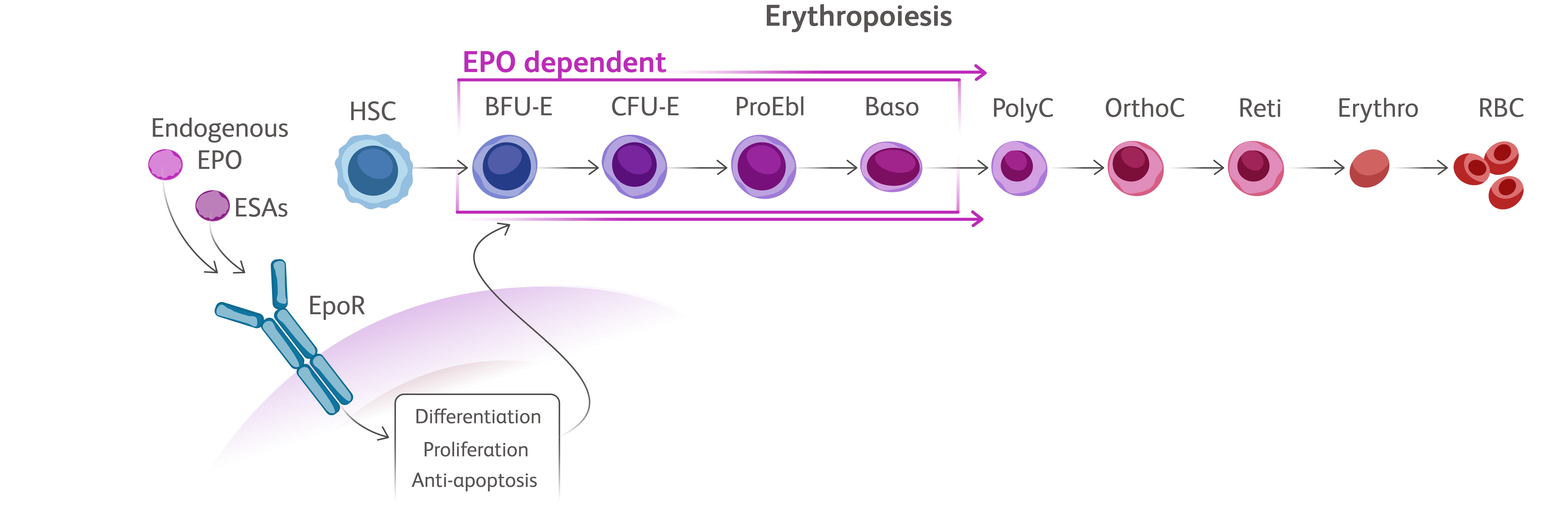
Pathogenic mutations in JAK2 that are associated with myeloproliferative neoplasm (MPN) pathogenesis trigger increased activation of erythropoietin receptor (EpoR) signaling, causing a disruption in effective erythropoiesis.Abraham BG et al. Sci Adv. 2024;10(10):eadl2097. Shi J et al. Exp Hematol. 2016;44(11):1044-1058.e5.

Baso, basophilic erythroblast; BFU-E, burst-forming unit erythroid cells; CFU-E, colony-forming unit erythroid cells; EPO, erythropoietin; Erythro, erythrocyte; HSC, hematopoietic stem cell; OrthoC, orthochromatic erythroblast; PolyC, polychromatic erythroblast; ProEbl, proerythroblast; Reti, reticulocyte.

EMAs bind TGF-β superfamily ligands to diminish downstream signaling of SMAD 2/3, thereby increasing RBC production which may improve anemia.Vinchi F et al. Hemasphere. 2024;8(3):e41. Trivedi G et al. Trends Mol Med. 2021;27(10):990-999. Elliot S et al. Ann Hematol. 2014;93:181-192.

Role in MF

ESAs may be used for managing anemia in patients with MF who are transfusion-independent and have low serum EPO (sEPO) levels, though studies have shown response rates in these patients to be variable.Naymagon L et al. Hemasphere. 2017;1(1):e1. Passamonti F et al. Crit Rev Oncol Hematol. 2022;180:103862.

Additional Studies and Considerations

ESAs may not be suitable for managing anemia in certain patient populations, such as those with:Naymagon L et al. Hemasphere. 2017;1(1):e1. Passamonti F et al. Crit Rev Oncol Hematol. 2022;180:103862.

  • High serum EPO levels (>500 mU/mL)
  • High RBC transfusion requirements

Semisynthetic Androgens

Androgens can affect several regulators of hematopoiesis, including stimulation of erythropoiesis via EpoR and immune cell modulation, though the exact mechanisms remain poorly understood.Al-Sharefi A et al. Front Endocrinol (Lausanne). 2019;10:754. Bosi A et al. Blood Rev. 2023;62:101132.

Semisynthetic androgens are chemically modified male sex hormones with altered pharmacodynamics and pharmacokinetics. Studies suggest that androgen administration may result in the production and secretion of EPO, leading to an improvement in erythropoiesis, though the exact mechanism is not fully understood.Al-Sharefi A et al. Front Endocrinol (Lausanne). 2019;10:754. Bosi A et al. Blood Rev. 2023;62:101132.

Role in MF

Certain semisynthetic androgens have been used to treat MF-related anemia; however, despite their tolerability, responses to semisynthetic androgens are limited regardless of transfusion burden.Naymagon L et al. Hemasphere. 2017;1(1):e1. Passamonti F et al. Crit Rev Oncol Hematol. 2022;180:103862. Garmezy B et al. Blood Rev. 2021;45:100691.

Additional Studies and Considerations

Androgens may not be suitable for managing anemia in certain patient populations, such as those who are transfusion-dependent due to low response rates. They are contraindicated in patients with androgen-dependent tumors, thrombosis or a history of thrombosis, impaired cardiac, hepatic, or renal function, and in pregnancy/breastfeeding.Passamonti F et al. Crit Rev Oncol Hematol. 2022;180:103862.

Immunomodulatory Agents (IMiDs)

Elevated levels of proinflammatory cytokines can lead to functional iron deficiency and are responsible for most of the symptomatic burden associated with MF.Jain AG et al. Blood. 2025;145(16):1738-1746. Garmezy B et al. Blood Rev. 2021;45:100691.

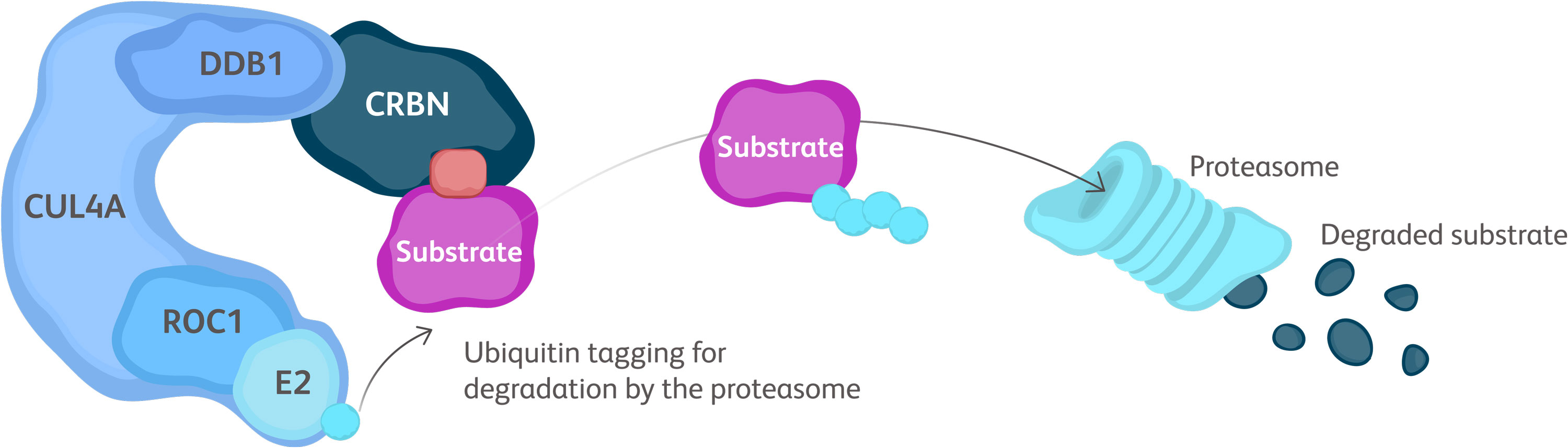
CUL4A, Cullin 4A; CRBN, cereblon; DDB1, damage-specific DNA binding protein 1; ROC1, ring-box 1.

IMiDs have been shown to inhibit the production of pro-inflammatory cytokines, elevate the production of anti-inflammatory cytokines, and activate immune cells to improve hematopoiesis. Though the exact mechanism in MF has yet to be determined, studies in other hematologic malignancies have shown IMiDs bind cereblon (CRBN) to recruit transcriptional regulators (eg, IKZF1 and IKZF3) for proteasomal degradation, leading to downstream modulation of cytokine expression and immune cell activity.Fink EC et al. Blood. 2015;126(21):2366-2369. Kotla V et al. J Hematol Oncol. 2009;2:36. Masarova L et al. Expert Rev Hematol. 2017;10(10):903-914.

Role in MF

IMiDs have been used for treating MF-associated anemia as monotherapy with limited success due to poor tolerability. Combination therapy with corticosteroids has been shown to reduce toxicity and modestly improve MF-associated anemia.Naymagon L et al. Hemasphere. 2017;1(1):e1. Garmezy B et al. Blood Rev. 2021;45:100691.

Additional Studies and Considerations

Ongoing clinical trials are investigating the use of IMiDs in combination with JAKis for the management of anemia in patients with MF.Passamonti F et al. Crit Rev Oncol Hematol. 2022;180:103862. Garmezy B et al. Blood Rev. 2021;45:100691. Gowin KL et al. Ther Clin Risk Manag. 2015;11:549-556.

Disease-directed therapies aim to alter MF biology

Disease-directed therapies target biological drivers of MF to improve survival outcomes and/or restore normal hematopoiesis in conjunction with bone marrow fibrosis.Pemmaraju N et al. Cancer. 2022;128(13):2420-2432.

A primary driver of MF, and thus a potential target for disease-directed therapy, is the JAK-signal transducer and activator of transcription (STAT) signaling pathway.Pemmaraju N et al. Cancer. 2022;128(13):2420-2432.

Janus Kinase Inhibitors

In MF, JAK-STAT signaling is constitutively activated by driver mutations, which are associated with increased cell proliferation, differentiation, and survival. It is important to note that JAKis alone do not robustly impact bone marrow fibrosis.Pemmaraju N et al. Cancer. 2022;128(13):2420-2432. Thaw K et al. Curr Hematol Malig Rep. 2024;19(6):264-275.

JAKis can bind to JAK1 and/or JAK2 proteins, and in some cases additional targets, and prevent phosphorylation and thus activation of the downstream STAT protein. This reduces but does not normalize excessive pro-inflammatory and pro-proliferative signaling during hematopoiesis. Importantly, some JAKis are associated with worsening anemia in patients with MF.Thaw K et al. Curr Hematol Malig Rep. 2024;19(6):264-275. Ostojic A et al. Ther Clin Risk Manag. 2012;8:95-103. Shantzer L et al. Ann Hematol. 2017;96(4):531-535.

Second-generation JAKis have been shown to alleviate MF-associated anemia potentially through dual inhibition of JAK1/2 and other signaling pathways involved in erythropoiesis and/or inflammation. For example, novel JAKis (nJAKis) may target JAK1/2 and activin A receptor type 1 (ACVR1), resulting in decreased hepcidin production and increased iron availability for erythropoiesis. Additionally, nJAKis may target other proteins, such as interleukin 1 receptor–associated kinase 1 (IRAK-1), to avoid myelosuppression and subsequently reduce hematopoietic inhibitory cytokines.Naymagon L et al. Hemasphere. 2017;1(1):e1. Thaw K et al. Curr Hematol Malig Rep. 2024;19(6):264-275. Martino M et al. Hematol Rep. 2024;16(4):698-713. Chifotides HT et al. J Hematol Oncol. 2021;15(1):7. Duminuco A et al. Cancers (Basel). 2023;16(1):154.

Role in MF

JAKis are approved for use in MF and are associated with reduced symptom burden and spleen size; however, they may also worsen MF-associated anemia. Novel JAKis are in development for improved anemia-specific outcomes in patients with MF.Passamonti F et al. Blood. 2023;141(16):1954-1970. Naymagon L et al. Hemasphere. 2017;1(1):e1. Passamonti F et al. Crit Rev Oncol Hematol. 2022;180:103862. Pemmaraju N et al. Cancer. 2022;128(13):2420-2432. Thaw K et al. Curr Hematol Malig Rep. 2024;19(6):264-275. Shantzer L et al. Ann Hematol. 2017;96(4):531-535.

Additional Studies and Considerations

Ongoing clinical trials are investigating the combination of JAKis with other classes of targeted therapy includingPassamonti F et al. Blood. 2023;141(16):1954-1970. Thaw K et al. Curr Hematol Malig Rep. 2024;19(6):264-275. Martino M et al. Hematol Rep. 2024;16(4):698-713.

  • Bromodomain and extra-terminal (BET) inhibitors
  • B-cell lymphoma 2 (BCL2) inhibitors
  • Phosphatidylinositol 3-kinase (PI3K) inhibitors

Learn more