
Supportive Care in MF-Associated Anemia
The goal of supportive care is to improve quality of life by managing symptoms and complications associated with myelofibrosis (MF) or its treatment.Palliative care. American Cancer Society. Accessed April 9, 2026. https://www.cancer.org/cancer/supportive-care/palliative-care.html What is supportive care? Multinational Association of Supportive Care in Cancer. Accessed April 9, 2026. https://mascc.org/what-is-supportive-care/ Blood transfusions. American Cancer Society. Accessed May 14, 2026. https://www.cancer.org/cancer/supportive-care/blood-transfusions.html Myeloproliferative neoplasms (MPNs). Blood Cancer United. Accessed April 2, 2026. https://bloodcancerunited.org/blood-cancer/myeloproliferative-neoplasms-mpns Brennan-Cook J et al. J Palliat Med. 2025;28(2):257-264.
While supportive care does not directly treat the underlying disease, it can help with the following:Palliative care. American Cancer Society. Accessed April 9, 2026. https://www.cancer.org/cancer/supportive-care/palliative-care.html What is supportive care? Multinational Association of Supportive Care in Cancer. Accessed April 9, 2026. https://mascc.org/what-is-supportive-care/ Blood transfusions. American Cancer Society. Accessed May 14, 2026. https://www.cancer.org/cancer/supportive-care/blood-transfusions.html Myeloproliferative neoplasms (MPNs). Blood Cancer United. Accessed April 2, 2026. https://bloodcancerunited.org/blood-cancer/myeloproliferative-neoplasms-mpns Brennan-Cook J et al. J Palliat Med. 2025;28(2):257-264.
- Alleviation of physical symptoms
- Mitigation of the risk of certain complications
- Addressing of psychological and social challenges
- Identification of the need for further treatment or changes in ongoing treatment
Approaches to supportive care for patients with MF-associated anemia include—but are not limited to—red blood cell (RBC) transfusion, clinical monitoring and observation, lifestyle modification, and/or psychosocial support.Myeloproliferative neoplasms (MPNs). Blood Cancer United. Accessed April 2, 2026. https://bloodcancerunited.org/blood-cancer/myeloproliferative-neoplasms-mpns Brennan-Cook J et al. J Palliat Med. 2025;28(2):257-264. Verstovsek S. Ann Hematol. 2023;102(4):689–698. Yoon J, Pettit K. Expert Rev Hematol. 2021;14(7):607–619. Therapy, counseling, and support resources for people with cancer. American Cancer Society. Accessed April 9, 2026. https://www.cancer.org/cancer/supportive-care/therapy-counseling-and-support-resources.html

As MF progresses or complications such as anemia develop, active treatment is typically considered in addition to supportive care.Myeloproliferative neoplasms (MPNs). Blood Cancer United. Accessed April 2, 2026. https://bloodcancerunited.org/blood-cancer/myeloproliferative-neoplasms-mpns Verstovsek S. Ann Hematol. 2023;102(4):689–698. Garmezy B et al. Blood Rev. 2021;45:100691. Jain AG, Gerds AT. Blood. 2025;145(16):1738-1746.
Transfusions
RBC transfusions are an important part of supportive care for patients with symptomatic anemia associated with MF. Most patients with MF will require RBC transfusions at some point during the course of the disease.Jain AG, Gerds AT. Blood. 2025;145(16):1738-1746. Passamonti F et al. Crit Rev Oncol Hematol. 2022;180:103862. Chifotides HT et al. J Hematol Oncol. 2022;15(1):7. Naymagon L et al. Hemasphere. 2017;1(1):e1. Al-Ali HK et al. Cancers (Basel). 2024;16(23):4064. Tefferi A et al. Blood. 2024;144(17):1813-1820.
However, transfusion dependence has been associated with a variety of complications. Management approaches for MF-associated anemia aim to minimize dependence on RBC transfusions through additional treatment modalities.Jain AG, Gerds AT. Blood. 2025;145(16):1738-1746. Passamonti F et al. Crit Rev Oncol Hematol. 2022;180:103862. Chifotides HT et al. J Hematol Oncol. 2022;15(1):7. Naymagon L et al. Hemasphere. 2017;1(1):e1. Al-Ali HK et al. Cancers (Basel). 2024;16(23):4064. Tefferi A et al. Blood. 2024;144(17):1813-1820.
The need for RBC transfusions becomes more
prevalent over time in patients with primary MF (PMF).efferi A et al. Mayo Clin Proc. 2012;87(1):25-33.

Role of RBC transfusions in MF-associated anemiaMyeloproliferative neoplasms (MPNs). Blood Cancer United. Accessed April 2, 2026. https://bloodcancerunited.org/blood-cancer/myeloproliferative-neoplasms-mpns Brennan-Cook J et al. J Palliat Med. 2025;28(2):257-264. Garmezy B et al. Blood Rev. 2021;45:100691. Passamonti F et al. Crit Rev Oncol Hematol. 2022;180:103862.

Provides supplementation with RBCs to increase RBC count
Helps maintain hemoglobin at a level that is appropriate for the individual patient based on their disease risk and comorbidities
May help alleviate anemia-related symptoms including fatigue and weakness
However, anemia and RBC transfusion dependence are associated with clinical complicationsJain AG, Gerds AT. Blood. 2025;145(16):1738-1746. Passamonti F et al. Crit Rev Oncol Hematol. 2022;180:103862. Chifotides HT et al. J Hematol Oncol. 2022;15(1):7. Naymagon L et al. Hemasphere. 2017;1(1):e1.
Anemia and RBC transfusion dependence in MF may be associated withJain AG, Gerds AT. Blood. 2025;145(16):1738-1746. Passamonti F et al. Crit Rev Oncol Hematol. 2022;180:103862. Chifotides HT et al. J Hematol Oncol. 2022;15(1):7. Naymagon L et al. Hemasphere. 2017;1(1):e1.

To learn more, view the tabs below. Each tab contains helpful information.
Dependence on RBC transfusions imposes a substantial burden on patients and the healthcare system.
- Economic burdens of medical care are approximately 2x to 9x higher for patients with MF who require RBC transfusionsGerds AT et al. J Manag Care Spec Pharm. 2024;30(12):1395-1404.
- Patients with MF who require RBC transfusions spend approximately 4x to 6x more time managing their disease than those who do not require RBC transfusions, and they report negative impacts on their work, social, and daily lifePalandri F et al. Front Oncol. 2025;15:1549023.
Average impact of transfusions on work, social, and daily lifePalandri F et al. Front Oncol. 2025;15:1549023.

Reproduced with permission from Front Oncol.
Only responses from working patients were analyzed for the work life question.
Patients with MF who required at least 1 RBC transfusion over the previous year reported the extent to which transfusions interfere with their work, social, and daily life. On average, patients who were transfusion-dependent (TD) reported more substantial interference than patients who were transfusion-independent (TI).Palandri F et al. Front Oncol. 2025;15:1549023.
Multiple studies have reported a significant association between RBC transfusion dependence and reduced overall survival in patients with PMF.Nicolosi M et al. Leukemia. 2018;32(5):1254-1258. Tefferi A et al. Am J Hematol. 2010;85(1):14-17. Leitch HA et al. Hematol Oncol. 2010;28(1):40-48. Gangat N et al. J Clin Oncol. 2011;29(4):392-397. Elena C et al. Haematologica. 2011;96(1):167-170.

The need for RBC transfusions is a negative prognostic factor in patients with MF, which is incorporated into the Dynamic International Prognostic Scoring System (DIPSS)-Plus modelNicolosi M et al. Leukemia. 2018;32(5):1254-1258. Tefferi A et al. Am J Hematol. 2010;85(1):14-17. Leitch HA et al. Hematol Oncol. 2010;28(1):40-48. Gangat N et al. J Clin Oncol. 2011;29(4):392-397.

Median survival was significantly shorter in patients with MF who received transfusions at the time of diagnosis compared to those who did not (2.6 years vs 8 years, HR 3.9, 95% CI: 2.5-6.1, P < 0.001)

Patients with MF who became RBC-TD had a significantly worse survival compared to patients with MF who remained TI throughout the course of the disease (HR 7.8, 95% CI: 5.1-11.9, P < 0.001)
HR, hazard ratio; TD, transfusion-dependent; TI, transfusion-independent.
Alloimmunization is an immune response against foreign RBC antigens that can cause hemolytic reactions, which can make finding compatible blood for future transfusions more difficult. It is a well-known complication of RBC transfusions, and patients who regularly require RBC transfusions are at an increased risk for RBC alloimmunization.Jain AG, Gerds AT. Blood. 2025;145(16):1738-1746. Thein SL et al. Haematologica. 2020;105(3):539-544. Molina-Aguilar R et al. Transfus Med Hemother. 2020;47(2):152-159. Sotolongo G, Poisson JL. Transfusion. 2023;63(10):1803-1808.
- Among patients receiving RBC transfusions, patients with MF were reported to have a higher incidence of alloimmunization (~13%) compared to the general hospitalized population (~2%)Sotolongo G, Poisson JL. Transfusion. 2023;63(10):1803-1808.
Mechanism of RBC alloimmunizationThein SL et al. Haematologica. 2020;105(3):539-544. Molina-Aguilar R et al. Transfus Med Hemother. 2020;47(2):152-159. Stowell SR et al. Clin Dev Immunol. 2012;2012:307093.

Adapted from Haematologica.
Adapted from mechanisms of RBC alloimmunization in sickle cell disease.
Dependence on RBC transfusions may lead to iron overload, which can increase the risk of further complications like organ dysfunction and infections. While studies of it in MF are limited, iron overload due to frequent RBC transfusions remains a concern during treatment.Jain AG, Gerds AT. Blood. 2025;145(16):1738-1746. Leitch HA et al. Hematol Oncol. 2010;28(1):40-48. Carreau N et al. Blood Rev. 2016;30(5):349-356. Armand P et al. Blood. 2007;109(10):4586-4588. Weber S et al. Front Immunol. 2021;11:627662. Caocci G et al. Int J Hematol. 2020;111(5):614-618.
- In patients with MF, iron overload may increase the risk of cardiac complications and infectionsJain AG, Gerds AT. Blood. 2025;145(16):1738-1746. Leitch HA et al. Hematol Oncol. 2010;28(1):40-48. Carreau N et al. Blood Rev. 2016;30(5):349-356. Caocci G et al. Int J Hematol. 2020;111(5):614-618.
- In multiple hematologic malignancies, markers of iron overload have been identified as a risk factor for morbidity and mortality in patients undergoing hematopoietic stem cell transplantCarreau N et al. Blood Rev. 2016;30(5):349-356. Armand P et al. Blood. 2007;109(10):4586-4588.
Potential consequences of iron overloadWeber S et al. Front Immunol. 2021;11:627662.
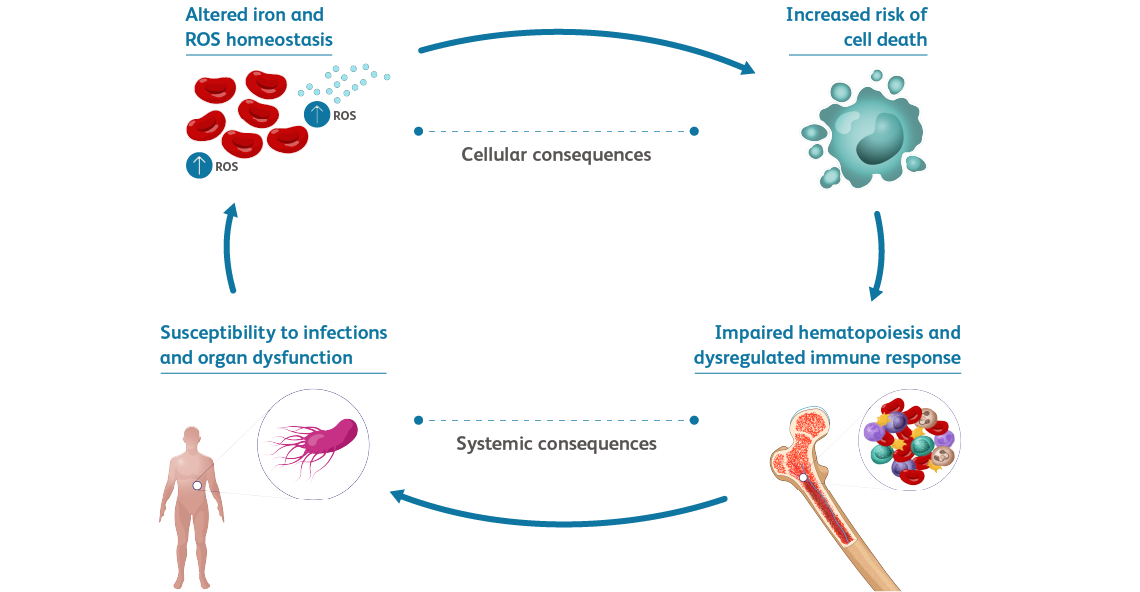
Adapted from Front Immunol.
ROS, reactive oxygen species.
Figure adapted from a source describing potential cellular and systemic consequences of iron overload in patients with MDS or acute myeloid leukemia (AML). Selected consequences are shown. Many of these factors are interwoven and may all together contribute to patient outcome.
Potential systemic consequences of iron overload include organ dysfunction and susceptibility to infections. Information about mechanisms of iron overload and its adverse effects is mostly based on studies of myelodysplastic syndromes (MDS) or other diseases that lead to anemia and chronic RBC transfusions.Leitch HA et al. Hematol Oncol. 2010;28(1):40-48. Carreau N et al. Blood Rev. 2016;30(5):349-356. Weber S et al. Front Immunol. 2021;11:627662. Caocci G et al. Int J Hematol. 2020;111(5):614-618.
Iron chelation therapy

Chelating agents bind to excess iron and remove it from the body to mitigate the risks and toxic effects of iron overload.Salimi Z et al. Ann Med Surg (Lond). 2024;86(5):2759-2776. Palumbo GA et al. Front Oncol. 2021;11:752192.

Treatment with chelating agents in patients with MF can be associated with nonhematologic adverse events like renal or hepatic impairment, gastrointestinal symptoms, and skin reactions.Palumbo GA et al. Front Oncol. 2021;11:752192.

Role in MF-associated iron overloadGarmezy B et al. Blood Rev. 2021;45:100691. Leitch HA et al. Hematol Oncol. 2010;28(1):40-48. Carreau N et al. Blood Rev. 2016;30(5):349-356. Palumbo GA et al. Front Oncol. 2021;11:752192. Passamonti F, Mora B. Blood. 2023;141(16):1954-1970.
The role of iron chelation therapy in MF remains unclear, and it is not routinely required. Patients who have received as few as 10-20 RBC units or who receive ≥2 RBC units per month may be at risk of iron overload.
- The use of chelating agents may be considered for certain patients who are RBC-TD with evidence of iron overload (eg, elevated ferritin levels and transferrin saturation)
- Iron chelation therapy may be considered for certain patients who are RBC-TD in preparation for hematopoietic stem cell transplant
Other forms of nonpharmacologic supportive care
In addition to RBC transfusions, management of patients with MF-associated anemia may also include other forms of nonpharmacologic supportive care like clinical monitoring and assessment, evaluation for and implementation of lifestyle modifications, and/or psychosocial support.Myeloproliferative neoplasms (MPNs). Blood Cancer United. Accessed April 2, 2026. https://bloodcancerunited.org/blood-cancer/myeloproliferative-neoplasms-mpns Brennan-Cook J et al. J Palliat Med. 2025;28(2):257-264. Verstovsek S. Ann Hematol. 2023;102(4):689–698. Yoon J, Pettit K. Expert Rev Hematol. 2021;14(7):607–619. Therapy, counseling, and support resources for people with cancer. American Cancer Society. Accessed April 9, 2026. https://www.cancer.org/cancer/supportive-care/therapy-counseling-and-support-resources.html

Clinical monitoring
and assessment
It is important to monitor patients with MF closely. Clinical and laboratory follow-up is used to identify changes in symptom status, treatment response, and signs of disease progression.Myeloproliferative neoplasms (MPNs). Blood Cancer United. Accessed April 2, 2026. https://bloodcancerunited.org/blood-cancer/myeloproliferative-neoplasms-mpns Brennan-Cook J et al. J Palliat Med. 2025;28(2):257-264. Garmezy B et al. Blood Rev. 2021;45:100691.
Follow-up frequency is adjusted depending on the stability of the disease, transfusion requirements, symptoms, and ongoing or planned treatment. Some patients with MF may see their doctor every 3-6 months, but many require monthly or weekly monitoring.Myeloproliferative neoplasms (MPNs). Blood Cancer United. Accessed April 2, 2026. https://bloodcancerunited.org/blood-cancer/myeloproliferative-neoplasms-mpns Brennan-Cook J et al. J Palliat Med. 2025;28(2):257-264. Garmezy B et al. Blood Rev. 2021;45:100691.

Lifestyle modifications
For patients with MF, lifestyle modifications can be an important part of managing symptoms like fatigue and reducing the risk of complications like thrombosis.Myeloproliferative neoplasms (MPNs). Blood Cancer United. Accessed April 2, 2026. https://bloodcancerunited.org/blood-cancer/myeloproliferative-neoplasms-mpns Brennan-Cook J et al. J Palliat Med. 2025;28(2):257-264. Yoon J, Pettit K. Expert Rev Hematol. 2021;14(7):607–619. Garmezy B et al. Blood Rev. 2021;45:100691.
Lifestyle modifications may include smoking cessation, healthy diet, incorporation of appropriate physical exercise, and planning or moderation of activity levels throughout the day.Myeloproliferative neoplasms (MPNs). Blood Cancer United. Accessed April 2, 2026. https://bloodcancerunited.org/blood-cancer/myeloproliferative-neoplasms-mpns Brennan-Cook J et al. J Palliat Med. 2025;28(2):257-264. Yoon J, Pettit K. Expert Rev Hematol. 2021;14(7):607–619. Garmezy B et al. Blood Rev. 2021;45:100691.

Psychosocial
support
Patients with MF may experience burdensome psychological symptoms like anxiety and depression that can impair their physical and social functioning.Brennan-Cook J et al. J Palliat Med. 2025;28(2):257-264. Yoon J, Pettit K. Expert Rev Hematol. 2021;14(7):607–619. Therapy, counseling, and support resources for people with cancer. American Cancer Society. Accessed April 9, 2026. https://www.cancer.org/cancer/supportive-care/therapy-counseling-and-support-resources.html
Psychosocial support aims to reduce patient distress by helping them cope with emotional, mental, and social challenges through services like counseling and patient support groups.Brennan-Cook J et al. J Palliat Med. 2025;28(2):257-264. Yoon J, Pettit K. Expert Rev Hematol. 2021;14(7):607–619. Therapy, counseling, and support resources for people with cancer. American Cancer Society. Accessed April 9, 2026. https://www.cancer.org/cancer/supportive-care/therapy-counseling-and-support-resources.html
Learn more

