
Classification of MDS
Establishing an accurate myelodysplastic syndromes (MDS) diagnosis and classification is important, as it impacts risk stratification and clinical decision makingHasserjian RP et al. Blood. 2023;142:2247-2257. Kasprzak A et al. Int J Environ Res Public Health. 2021;18:7629.
- Two updated classifications for MDS were developed in 2022: the World Health Organization 5th edition classification (WHO5) and the International Consensus Classification (ICC) of myeloid neoplasms and acute leukemiaHasserjian RP et al. Blood. 2023;142:2247-2257.
- Both classifications are similar, focusing on integrating molecular/genetic findings and refining the correlation between morphologic and clinical phenotypes; however, there are differences in the diagnostic criteria and nomenclature, highlighting the importance of considering both classifications when making a diagnosisHasserjian RP et al. Blood. 2023;142:2247-2257. Xu ML, Hasserjian RP. Cancer J. 2023;29:122-129.
Overview of WHO5 and ICC MDS classificationHasserjian RP et al. Blood. 2023;142:2247-2257. Arber DA et al. Blood. 2022;140:1200-1228. Khoury JD et al. Leukemia. 2022;36:1703-1719.
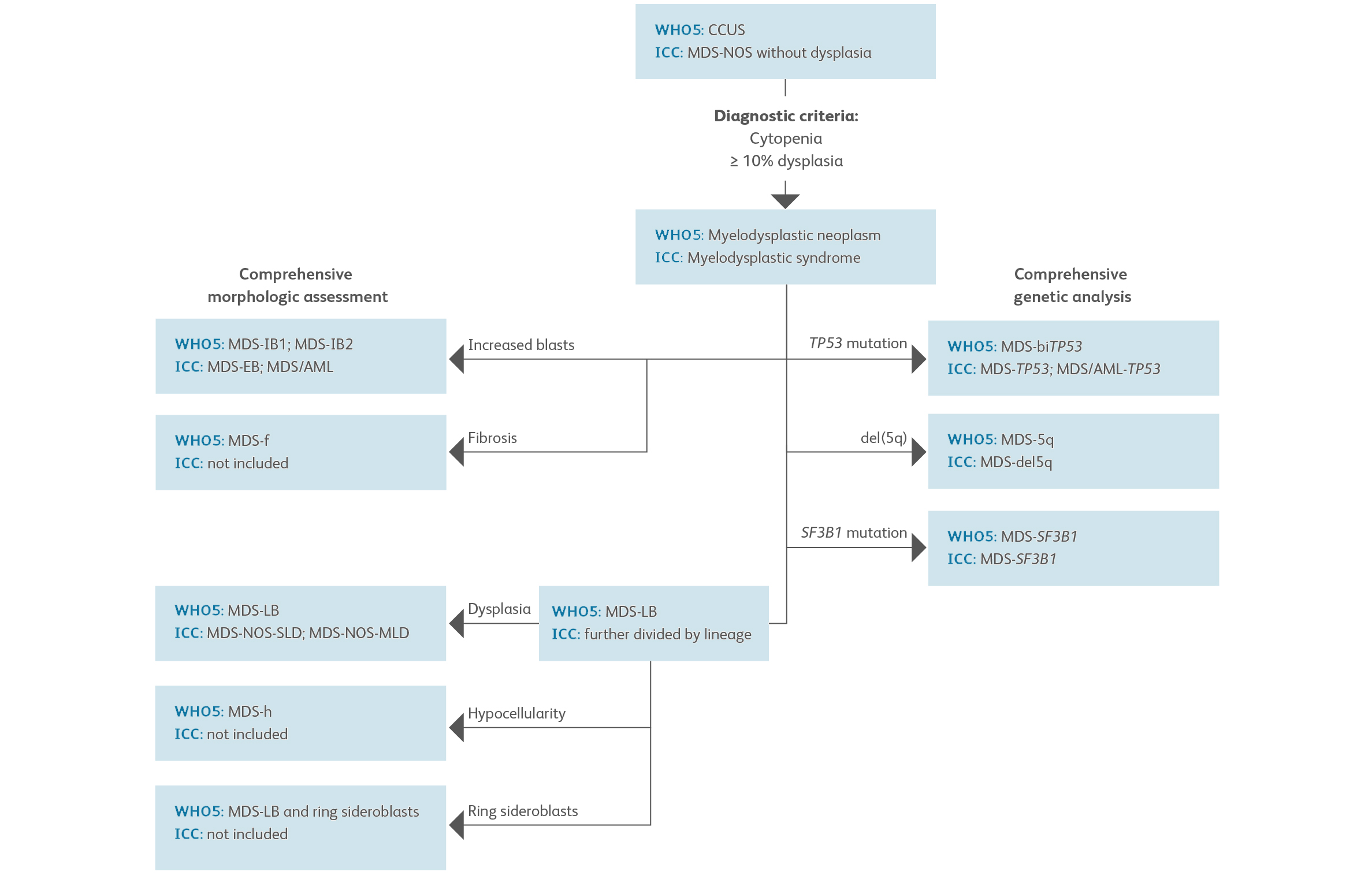
Adapted with permission from Blood.Hasserjian RP et al. Blood. 2023;142:2247-2257.
ICC, International Consensus Classification; MDS/AML, myelodysplastic syndromes/acute myeloid leukemia overlap; MDS/AML-TP53, TP53-mutated myelodysplastic syndromes/acute myeloid leukemia overlap; MDS-5q, myelodysplastic syndromes with low blasts and isolated 5q deletion; MDS-biTP53, myelodysplastic syndromes with biallelic TP53 inactivation; MDS-del5q, myelodysplastic syndromes with 5q deletion; MDS-EB, myelodysplastic syndromes with excess blasts; MDS-f, myelodysplastic syndromes with fibrosis; MDS-h, hypoplastic myelodysplastic syndromes; MDS-IB1, myelodysplastic syndromes with increased blasts 1; MDS-IB2, myelodysplastic syndromes with increased blasts 2; MDS-LB, myelodysplastic syndromes with low blasts; MDS-NOS, myelodysplastic syndromes, not otherwise specified; MDS-NOS-MLD, myelodysplastic syndromes, not otherwise specified, multilineage dysplasia; MDS-NOS-SLD, myelodysplastic syndromes, not otherwise specified, single-lineage dysplasia; MDS-SF3B1, myelodysplastic syndromes with SF3B1 mutation; MDS-TP53, mutated TP53 myelodysplastic syndromes; WHO5, World Health Organization 5th edition classification.
MDS classification according to WHO5Khoury JD et al. Leukemia. 2022;36:1703-1719.
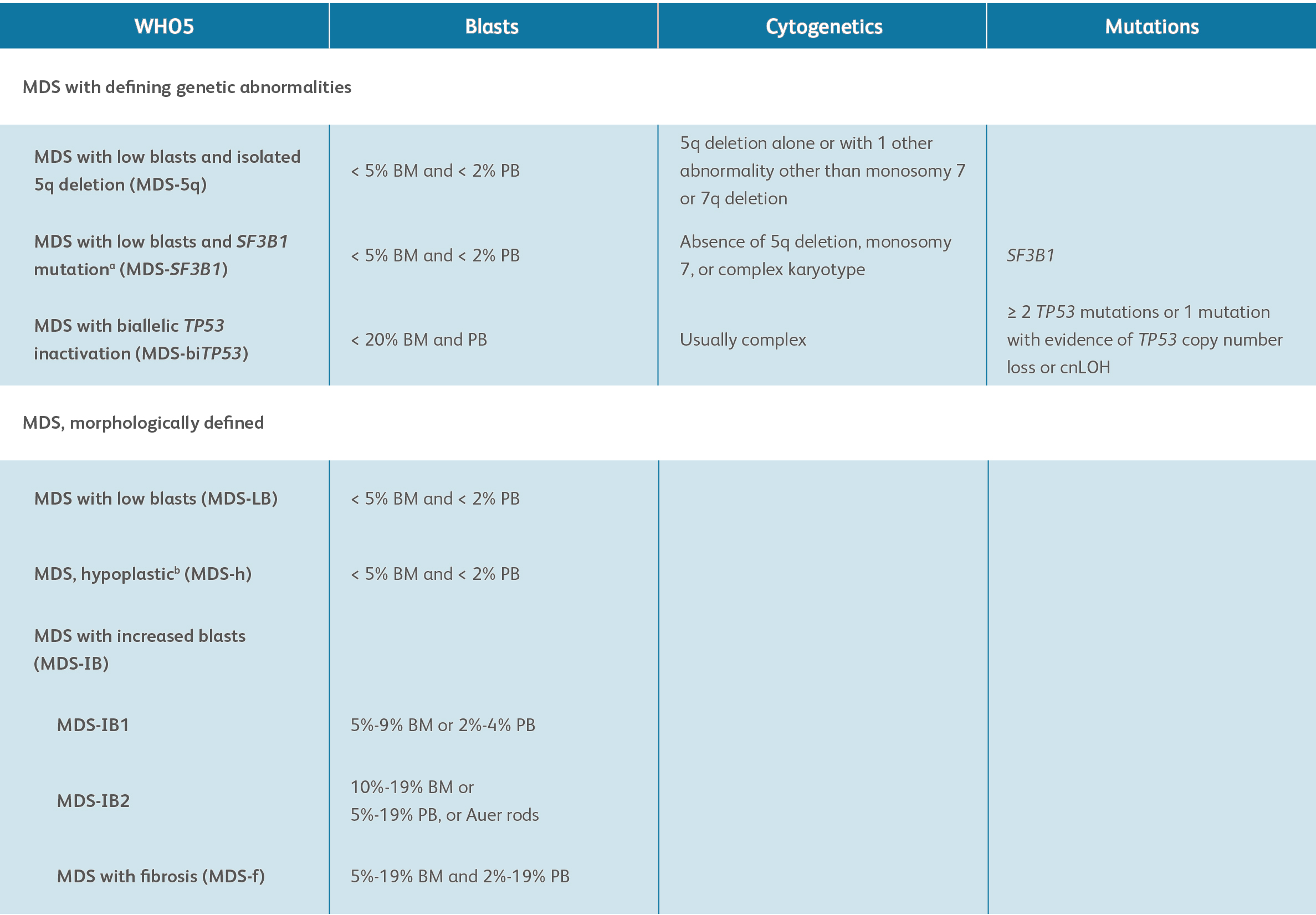
Reproduced with permission from Leukemia.Khoury JD et al. Leukemia. 2022;36:1703-1719.
a Detection of ≥ 15% ring sideroblasts may substitute for SF3B1 mutation (MDS with low blasts and ring sideroblasts).
b By definition, ≤ 25% bone marrow cellularity, age adjusted.
BM, bone marrow; cnLOH, copy neutral loss of heterozygosity; PB, peripheral blood.
MDS classification according to ICCArber DA et al. Blood. 2022;140:1200-1228. Hasserjian RP et al. Virchows Arch. 2023;482:39-51.
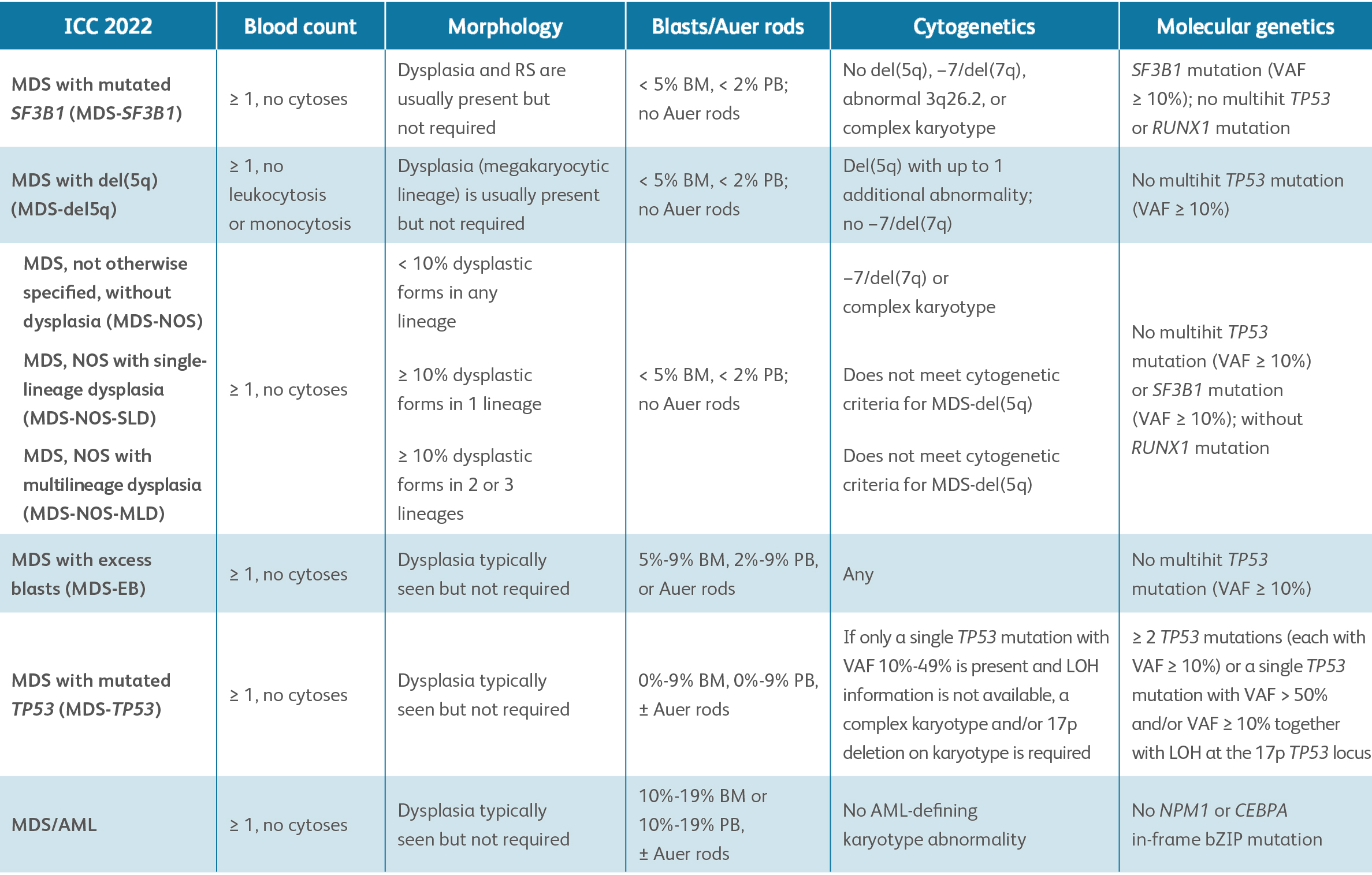
Reproduced with permission from Blood.Arber DA et al. Blood. 2022;140:1200-1228.
BM, bone marrow; PB, peripheral blood; RS, ring sideroblasts; VAF, variant allele frequency.
Learn more

